
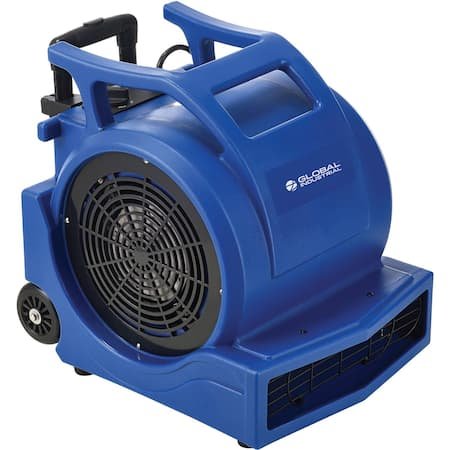
The Bissell BigGreen commercial air mover BGAM3000 is a portable high-velocity fan designed to move air across floors, carpets, furnishings, and other surfaces during cleaning and drying work. It is intended for commercial environments where a floor-care team needs controlled airflow after extraction, routine cleaning, a spill, or a limited water incident. It is not a dehumidifier, wet vacuum, or complete water-damage restoration system. Its job is to circulate air and help moisture evaporate from exposed surfaces.
Before purchasing any commercial air mover, it helps to understand what airflow ratings mean, how adjustable positions affect drying, and what other equipment may be required. This guide reviews the manufacturer-published BGAM3000 specifications, explains practical applications, and gives facility managers, cleaning contractors, and property operators a method for assessing whether this model fits their work.
What the BGAM3000 Is Designed to Do
An air mover creates a directed stream of air. When that stream passes over a damp surface, it can increase evaporation by moving the humid boundary layer that forms just above the material. This is useful after carpet extraction, hard-floor cleaning, upholstery treatment, or a small spill. It can also help circulate air in a room while other drying equipment is operating. The BGAM3000’s adjustable airflow direction gives an operator more than one way to aim the stream depending on the surface and the available space.
The distinction between air movement and moisture removal is important. An air mover does not collect liquid water and does not independently remove water vapour from a closed room. In a humid space, moisture released from wet carpet or furnishings can remain in the air unless ventilation or dehumidification is also provided. For routine cleaning, a fan may be all that is needed to speed surface drying. For building water damage, the drying plan should be based on the amount of water, the materials affected, and measurements over time.
Published Specifications and Main Features
Bissell BigGreen Commercial’s specification sheet identifies the item as BGAM3000. It lists a 9.5-inch blower fan, three speed settings, airflow ratings of 2,400, 2,700, and 3,000 cubic feet per minute, and a heavy-duty polyethylene housing. It also describes four adjustable positions, a kickstand, stackable construction, and a 25-foot safety cord. The published dimensions are approximately 18 inches high, 18.75 inches long, and 17.375 inches wide. The sheet lists a weight of about 30 pounds and a one-year warranty on the motor and housing.
These details are useful for initial comparison, but specifications should always be checked against the product supplied. Older stock, revised documentation, regional electrical configurations, or a marketplace listing for a similar model can cause confusion. The manufacturer’s specification sheet also contains slightly different current-draw figures in its descriptive text and technical table. Buyers who need an exact electrical load for circuit planning should confirm the rating on the unit’s nameplate or obtain clarification from Bissell rather than relying on an inconsistent summary line.
Understanding the Three Airflow Settings
The three stated airflow settings give an operator a way to match air movement to the task. The highest setting may be appropriate when rapid air circulation is needed across an open floor area. A lower setting can be more practical in a small room, near light objects, or where a powerful stream might disturb paperwork, dust, curtains, or lightweight materials. The middle setting provides an intermediate option. The best setting is the one that provides useful surface airflow without creating avoidable noise, movement, or safety problems.
Airflow figures are not a promise that every room will dry at the same speed. Drying time also depends on the amount of water, the material, room temperature, relative humidity, ventilation, air path, and whether furniture or carpet padding is wet. A high CFM rating can support faster evaporation, but it cannot overcome a hidden moisture source or a saturated material that requires extraction. Operators should treat airflow as one part of a controlled drying process.
Four Positions and Practical Applications
The manufacturer describes four drying positions that allow the air stream to be directed toward different targets. A low, floor-facing position can help move air across hard flooring or carpet. An angled position may direct airflow toward upholstery or a lower section of a wall. More upright positioning can be useful for curtains or other surfaces where the airflow needs to travel vertically. The kickstand supports positioning, but it should be set on a stable surface and checked before the motor is switched on.
For carpet cleaning, place the unit so air travels across the damp area rather than blowing debris toward an occupied walkway. For hard floors, keep cords and equipment outside wet traffic paths and use signs to alert people that the floor is drying. For upholstery, consider the fabric’s care instructions and avoid an overly forceful stream that could move loose items or affect delicate materials. A controlled arrangement is safer and usually more useful than simply pointing the fan at the wettest-looking area.
Stacking, Portability, and Storage
The specification sheet says that air movers can be stacked up to three high. Stackability can reduce storage space for cleaning companies, hotels, schools, and maintenance departments that keep several units. However, stackable design does not mean that every storage arrangement is automatically safe. Follow the manufacturer’s stacking instructions, make sure the stack is stable, and do not block the intake or outlet. Never place units in a way that creates a falling hazard or damages their electrical cords.
At around 30 pounds, the BGAM3000 is portable but not weightless. Staff should use safe lifting technique, especially when transporting several units between floors or loading a vehicle. Inspect the housing for cracks, check the kickstand and handle areas, and coil the power cord loosely rather than wrapping it tightly around a sharp edge. Store the machine in a dry location, protect the plug from impact, and avoid placing heavy objects on top of the housing.
Electrical and Workplace Safety
Before use, inspect the cord, plug, housing, switches, and outlet screen. Do not operate a unit with exposed wiring, a damaged plug, unusual vibration, or a burning smell. Keep the fan away from standing water and follow the manufacturer’s electrical instructions. The listed long cord offers placement flexibility, but a long cord does not remove the need to assess circuit capacity, extension-cord rules, and trip hazards. Use only power arrangements approved for the device and the worksite.
Air movers can create strong airflow and noticeable sound. Position them so the outlet is not aimed at people, loose materials, or surfaces that could release dust. Keep children and untrained visitors away from operating equipment. Staff should know how to switch the unit off, unplug it safely, and report abnormal noise or heat. In commercial premises, a documented inspection routine helps ensure that a portable fan is not returned to service after damage without assessment.
How to Use an Air Mover as Part of a Drying Plan
Start by identifying and stopping the source of moisture. Remove standing water with suitable extraction equipment, then determine which materials are wet and whether any need to be removed or professionally assessed. Place air movers to create a deliberate airflow path across exposed surfaces. Avoid arranging fans in a way that simply pushes moist air into an enclosed corner. In some settings, dehumidification and controlled ventilation may be necessary to manage the water vapour released into the room.
Monitor the drying result rather than assuming that a surface is dry because it feels less damp. Carpet backing, padding, subfloors, and cavities may retain moisture after the visible surface appears dry. Larger water events can involve electrical hazards, contaminated water, structural materials, and hidden wet areas. These situations call for a qualified restoration professional and an appropriate assessment, not just additional fans.
Cleaning and Routine Maintenance
Disconnect the unit from power before cleaning or inspecting it. Remove accessible dust and debris from the intake and outlet screen using a method approved by the manufacturer. Do not insert tools through the grille or spray liquid into the motor housing. Wipe the exterior with a suitable lightly damp cloth if the manual allows it, then let the housing dry before reconnecting power. A clean intake helps maintain airflow and reduces the chance that accumulated debris will be drawn into the machine.
Set a maintenance log for commercial use. Record the date of inspection, cord condition, switch operation, visible damage, unusual sound, and any service work. If a unit has been exposed to a flood, chemical spill, or contaminated water, do not return it to service until it has been assessed and cleaned using a safe procedure. A fan that appears to run normally may still have electrical or internal contamination issues.
How to Compare the BGAM3000 With Other Air Movers
Compare models on more than the maximum airflow number. Consider the range of speed settings, drying angles, housing construction, cord length, weight, noise, stackability, warranty, availability of service parts, and the type of work your team performs. A unit with a slightly lower maximum airflow may be easier to position in tight spaces or transport daily. Conversely, a facility that dries broad floor areas may value the highest airflow and a stable design.
Calculate total cost of ownership. The purchase price is only one element. Add replacement parts, inspection time, storage requirements, training, repairs, and the cost of downtime if a unit fails during a busy schedule. Confirm whether the warranty is valid for the intended commercial use and whether the seller is an authorized or established supplier. Ask for a current specification sheet and verify that the model number on the carton and the unit both read BGAM3000.
Questions to Ask Before Ordering
Ask whether the machine is new, refurbished, or used, and request clear photographs of the actual unit if buying second-hand. Confirm the warranty, return period, electrical configuration, and whether accessories or documentation are included. If the unit is being purchased for a facility, ask the supplier for the current nameplate specifications so the maintenance team can check power requirements. A detailed answer is more useful than a listing that repeats a product title without identifying condition or included items.
For a used machine, request a video showing all speed settings and each adjustable position. Listen for rattling, scraping, or inconsistent motor sound. Check that the kickstand locks or supports the machine as intended and that the cord has no cuts or repairs. A low price is not necessarily good value if the fan needs a motor repair, has a damaged housing, or comes without a safe power cord.
Who May Benefit From This Model?
The BGAM3000 may be relevant to commercial cleaning contractors, janitorial teams, carpet-cleaning businesses, hotel maintenance departments, schools, and property managers. It is most useful when the work involves repeated surface drying and the operator needs a portable machine with several airflow settings and positions. A household user with occasional small spills may not need a commercial-grade unit. The decision should reflect frequency of use, storage space, staff handling, and the consequences of downtime.
For a contractor, several units can support a more consistent workflow across multiple rooms. For a hotel, the ability to store equipment compactly may be valuable. For a school, cord management and access control are especially important because equipment may be used near students and public spaces. Each user should create a short operating procedure that explains who may set up the unit, where it may be placed, how it is inspected, and when the job must be escalated.
Manufacturer Information and Further Reading
Use the Bissell BigGreen Commercial BGAM3000 specification sheet as the primary reference for product dimensions, airflow settings, positioning, and the stated warranty. Because the document is older, verify current availability, support, and warranty terms with the manufacturer or seller at the time of purchase. Do not treat third-party listings as a substitute for the product nameplate or current instructions.
Frequently Asked Questions
What is the Bissell BigGreen BGAM3000 used for?
It is a commercial air mover designed to circulate air and support drying after cleaning or minor water incidents. It does not collect liquid water or remove humidity like a dehumidifier.
How much airflow does the BGAM3000 provide?
The manufacturer’s specification sheet lists three settings of 2,400, 2,700, and 3,000 CFM. Verify the documentation supplied with the exact unit before using those figures for technical planning.
Can the BGAM3000 be used to dry carpet?
It can help move air across damp carpet and nearby surfaces. It should be used alongside appropriate extraction and moisture checks, and it is not a substitute for professional drying after extensive water damage.
Can the BGAM3000 be stacked?
The product sheet describes stackable construction and says units can be stacked up to three high. Follow the current manufacturer’s instructions and keep any stack stable and clear of airflow obstructions.
Is an air mover enough after a flood?
No. Floodwater or major water damage may involve contamination, hidden moisture, and electrical or structural risks. A qualified restoration professional should assess affected materials and determine the correct drying process.
Conclusion
The Bissell BigGreen commercial air mover BGAM3000 is a portable, multi-position air mover designed for commercial cleaning and targeted drying work. Its stated three-speed airflow, adjustable positions, stackable housing, and long power cord make it a practical model to evaluate for facilities and cleaning teams. Before purchasing, confirm the exact model, electrical rating, warranty, condition, and seller support. Use it as part of a measured drying plan, and seek professional restoration help when water damage is extensive or potentially contaminated.
